







AI search optimisation for B2B SaaS: how to get cited by ChatGPT, Google and Claude
Buyers now ask ChatGPT, Google AI Mode and Claude which software to shortlist. This guide explains how AI search picks its sources and what a B2B SaaS company can do to be one of them.

Written by
SaaS Hackers- AI
- SEO
- Content & SEO
- Emerging Modern Challenges
- Guide

Quick answer: AI search optimisation is the work of getting your product found, cited and recommended inside AI answers from ChatGPT, Google AI Overviews and AI Mode, Claude, Perplexity and Copilot. For a B2B SaaS company it rests on three things: letting the AI search crawlers in, publishing pages that answer buyers' questions plainly, and being described accurately on the review sites, lists and communities those tools read.
Software buyers used to start with a Google search and a dozen open tabs. Now many start with a single question to an AI assistant, and the answer names three or four products before anyone visits a website. If your product isn't in that answer, it may never make the shortlist.
This guide is for SaaS founders and marketing leads who want a plain account of how AI search works and what to do about it. It covers how each major assistant finds sources, what makes a page worth citing, the off-site signals that get a brand mentioned, the technical set-up, how to measure it, and a 90-day plan. If you want the wider picture of search first, start with our B2B SaaS SEO strategy guide, which this guide builds on.
What is AI search optimisation?
AI search optimisation is the practice of making your brand, product and content easy for AI assistants to find, understand and cite when they answer a question. It sits alongside SEO rather than replacing it, because most AI answers are built from pages that a search index has already crawled.
You'll see the same work under several names. Generative engine optimisation (GEO) usually means getting cited in answers written by large language models.
Answer engine optimisation (AEO) is an older term that began with featured snippets and voice search and now covers AI answers too. LLM SEO is a looser label for the same thing. The names matter less than the job: when a buyer asks an assistant about your category, your product should be in the answer, described correctly.
The difference from classic SEO is the unit of success. In SEO you win a position on a results page and hope for a click.
In AI search you win a mention or a citation inside an answer, and the click is optional. A buyer can read that your product “integrates with Xero and suits mid-sized finance teams” and add you to the shortlist without visiting your site. Our explainer on what answer engine optimisation is covers the history of the term in more depth.
How are B2B SaaS buyers using AI search?
B2B software buyers now use AI assistants to build shortlists, so AI search affects which vendors get considered at all. The research is consistent on this, even if the exact figures vary by survey.
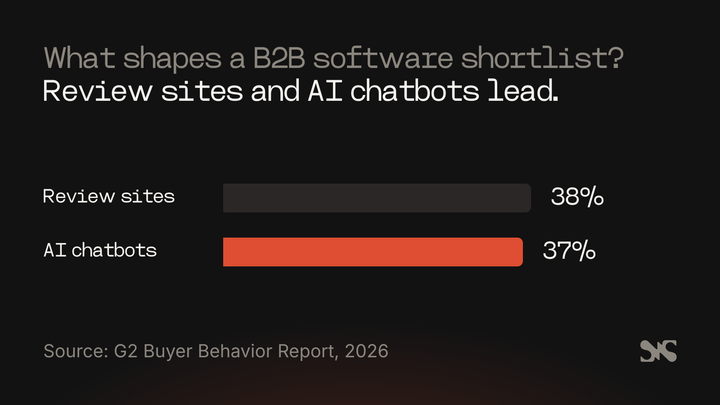
G2 surveyed 1,038 B2B decision-makers in June 2026. More than 80% had sourced software recommendations from an AI chatbot in the last two years, and among those buyers, half said AI had the greatest influence during shortlisting and evaluation (G2, 2026). The same survey found the two biggest influences on shortlists were review sites (38%) and AI chatbots (37%).
Gartner's survey of 646 B2B buyers, run in August and September 2025, found 45% had used AI during a recent purchase and 67% preferred a buying experience without a sales rep (Gartner, 2026). Put together, the picture is a buyer who researches alone, asks an assistant for options, then checks reviews before talking to anyone.
Two things follow for a SaaS company. First, the assistant's answer is now part of your shop window, and you don't write it. Second, review sites and AI answers feed each other: assistants read review sites, and buyers check reviews after the assistant names you, so work on one helps the other.
How do ChatGPT, Google, Claude, Perplexity and Copilot find their sources?
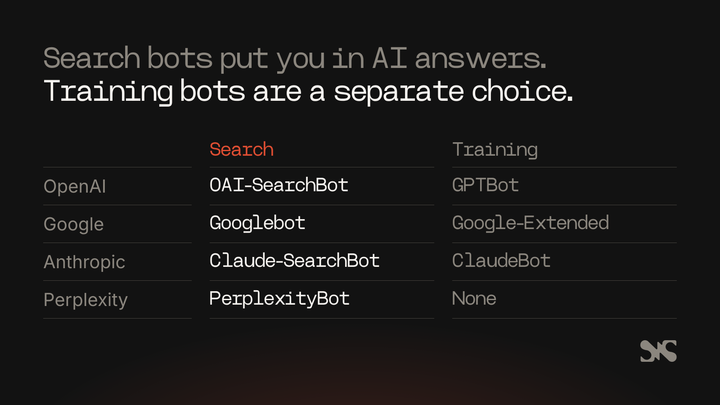
Every major AI assistant that answers with live information fetches web pages through its own crawler or a search index, and each vendor documents how site owners can allow or block it. Knowing which crawler does what is the first technical step, because blocking the wrong one quietly removes you from answers.
ChatGPT search
ChatGPT searches the web when a question would benefit from current information, and answers that use search can include citations (OpenAI, 2026). It sometimes sends the question to third-party search providers, rewriting it into one or more targeted queries first. To be eligible, OpenAI says a site should allow OAI-SearchBot and make sure its host or CDN accepts traffic from OpenAI's published IP addresses.
OpenAI runs three separate agents (OpenAI, 2026):
- OAI-SearchBot surfaces websites in ChatGPT's search features. Sites that block it won't be shown in ChatGPT search answers, though they can still appear as navigational links.
- GPTBot crawls content that may be used to train OpenAI's models. Blocking it is a training opt-out and doesn't affect search.
- ChatGPT-User visits a page when a person's request needs it. OpenAI says robots.txt rules may not apply to these user-initiated visits.
Google AI Overviews and AI Mode
Google's AI Overviews summarise a topic at the top of some results pages, and AI Mode is a conversational search for harder questions. Both may use a “query fan-out” technique, running several related searches across subtopics before writing a response (Google Search Central, 2025). Google says a page only needs to be indexed and eligible for a snippet to appear as a supporting link, and that “there are no additional technical requirements”.
Google-Extended is a separate robots.txt token. It controls whether Google may use your content to train future Gemini models and for grounding in the Gemini apps, and Google states it “does not impact a site's inclusion in Google Search nor is it used as a ranking signal” (Google, 2026).
Claude
When Claude's web search is on, it searches the live web, processes several sources and includes citations in every response (Anthropic, 2026). Anthropic separates its agents in the same way OpenAI does: Claude-SearchBot indexes content to improve search results, Claude-User fetches pages when a person asks Claude a question, and ClaudeBot collects content that may be used for training. Anthropic notes that blocking Claude-SearchBot or Claude-User may reduce your visibility in Claude's answers, while blocking ClaudeBot opts future content out of training.
Perplexity
PerplexityBot surfaces and links websites in Perplexity's search results and, Perplexity says, is not used to crawl content for AI foundation models (Perplexity, 2026). Perplexity-User visits pages when someone asks a question and links to them in the answer; because a person requested the fetch, it generally ignores robots.txt. Perplexity recommends allowing PerplexityBot and its published IP ranges if you want to appear.
Microsoft Copilot
Microsoft's AI Performance report in Bing Webmaster Tools shows how often your content is cited across Microsoft Copilot, AI-generated summaries in Bing and some partner integrations (Microsoft Bing, 2026). If your site isn't verified in Bing Webmaster Tools, you're missing the only first-party citation data any of these vendors currently offers.
How is AI search optimisation different from SEO?
AI search optimisation uses the same foundations as SEO, but it rewards pages that answer one question clearly and brands that other sites describe consistently. Google says the same SEO best practices apply to its AI features, and the other assistants lean on search indexes too, so a technically sound site with useful content is still the starting point.
Three things change in practice:
- Questions get broken into parts. Query fan-out means one buyer question becomes several smaller searches about features, pricing, integrations and reviews. A focused page on each of those gives you several ways into one answer, where a single long product page might give you none.
- Other people's words count more. An assistant asked “what's the best SOC 2 automation tool for a seed-stage startup” leans on comparison articles, review sites and forum threads, not just vendor pages. What others say about you shapes the answer.
- Clicks fall even when you're cited. An answer that names your product may satisfy the buyer without a visit. Google says clicks from results pages with AI Overviews are “higher quality”, with people more likely to spend more time on the site (Google Search Central, 2025), but there will be fewer of them for simple questions.
So keep doing SEO well, then add answer-first writing, buyer-intent pages and off-site reputation work on top.
What makes a page likely to be cited in an AI answer?
AI assistants cite pages that state a clear, specific answer near the top, back it with facts, and are easy to crawl and read as text. None of the vendors publishes a citation formula, so treat the points below as good practice drawn from their documentation and from how answers are built, not as a guarantee.
- Open each section with one or two sentences that answer its heading on their own. Assistants lift passages, and a passage that needs the paragraph before it to make sense is hard to lift.
- Give each section one question, and phrase headings the way buyers ask: “Does [product] integrate with Salesforce?” or “How much does SOC 2 automation cost?” This matches the smaller searches that fan-out produces.
- Be specific. Name the integrations, team sizes, industries, regions and plan limits. “Works for growing teams” gives an assistant nothing to repeat. “Built for finance teams that close the month in Xero or QuickBooks” does.
- Show the evidence: customer names you're allowed to use, published results, certifications and dates. Assistants and buyers both trust a claim with a source.
- Keep it current. Out-of-date pricing or a discontinued feature can end up repeated in answers for months. Put a visible “last updated” date on pages that change.
- Make it readable as text. Google advises keeping important content in text form and making structured data match the visible text (Google Search Central, 2025). Key facts hidden in images, tabs that need a click, or PDFs are harder for any crawler to use.
Our B2B SaaS content marketing guide covers how to plan content that does this at scale.
Which pages should a SaaS company build for AI search?
The pages that earn AI citations for SaaS are the ones that answer buying questions: comparisons, alternatives, pricing, integrations, use cases and honest category explainers. These are the questions buyers put to assistants when they're building a shortlist, and they're often the pages SaaS sites are thinnest on.
| Page type | The buyer question it answers |
|---|---|
| Comparison (you vs a competitor) | Which is better for my situation, A or B? |
| Alternatives | What else should I look at besides the market leader? |
| Pricing | What will this cost for a team like mine? |
| Integration pages | Does it work with the tools we already use? |
| Use case and industry pages | Is it built for companies like ours? |
| Category explainer | What is this type of software and do I need it? |
| Security and compliance | Will it pass our IT and security review? |
Write comparison and alternatives pages fairly. An assistant comparing two products draws on several sources, and a page that pretends a competitor has no strengths reads as marketing and gets passed over. Say who each option suits best, including when that's not you.
Publish your pricing, or at least your pricing model and starting point, if you can. When it isn't public, assistants fill the gap with whatever a review site or old forum post says. The same goes for security: a clear security page with your certifications answers the questions an IT reviewer will otherwise put to an assistant, or to you, late in the deal.
How do you get your brand mentioned on other sites?
AI answers about a software category repeat what independent sites say, so being described accurately on review sites, comparison lists, communities and in the press is as important as your own pages. This is the part of AI search optimisation that looks most like PR.
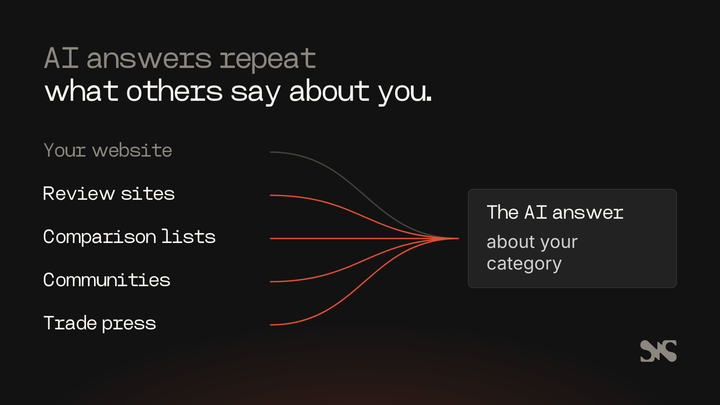
Review sites. Keep your G2, Capterra and similar profiles complete, with the same category, positioning and integrations as your website. Ask happy customers for reviews regularly rather than in one burst. G2's research puts review sites level with AI chatbots as a shortlist influence, and assistants read them.
Comparison and “best of” lists. Find the lists that rank for your category and ask to be considered, with accurate facts and a clear note of who you suit. Make it easy for the writer: a short fact sheet with pricing, integrations and customer examples.
Communities. Reddit, Slack groups, LinkedIn and specialist forums are where buyers ask each other for recommendations, and those threads get cited. Take part as a named person who helps, not as a brand dropping links. Our post on using Reddit in SaaS marketing covers how to do this without getting banned.
Digital PR. Original research, data from your product and expert comment get you mentioned in the trade press, which assistants treat as independent sources. See our guide to how digital PR builds links for SaaS.
Consistency. Use the same company description, category and product names everywhere: website, LinkedIn, Crunchbase, review sites, partner directories and press boilerplate. When sources disagree about what you do, assistants hedge or leave you out.
How do you set up your site technically for AI crawlers?
The technical set-up for AI search is mostly about access: letting the search crawlers in at the robots.txt and CDN level, keeping key content in HTML text, and adding structured data that matches the page. Start with access: a crawler that is blocked can't cite you, whatever the page says.
Check robots.txt and your CDN
Decide which crawlers you want, then check both your robots.txt and your CDN or firewall settings, because a bot blocked at the edge never reads robots.txt. A common set-up for a SaaS company that wants to appear in AI answers but not be used for training looks like this:
| User agent | Vendor | What it does | Typical choice |
|---|---|---|---|
| Googlebot | Search, including AI Overviews and AI Mode | Allow | |
| OAI-SearchBot | OpenAI | ChatGPT search | Allow |
| Claude-SearchBot | Anthropic | Claude search results | Allow |
| PerplexityBot | Perplexity | Perplexity search results | Allow |
| Bingbot | Microsoft | Bing and Copilot | Allow |
| GPTBot | OpenAI | Model training | Your choice |
| ClaudeBot | Anthropic | Model training | Your choice |
| Google-Extended | Gemini training and grounding | Your choice |
OpenAI says changes to robots.txt can take around 24 hours to affect search results, and Perplexity says up to 24 hours (OpenAI, 2026; Perplexity, 2026). Blocking training crawlers is a business decision; blocking search crawlers is almost always a mistake for a company that wants to be found.
Keep content in the HTML
Make sure product facts, pricing and FAQs are in the page's text, not only in images, PDFs or content that loads after a click. Google lists this among the basics for its AI features. If your marketing site is a JavaScript app, check what a crawler sees by viewing the raw HTML. Server-rendered or static pages avoid most of this problem.
Structured data
Use structured data (schema.org markup) to state facts in a form machines read reliably: Organization for your company, SoftwareApplication or Product for what you sell, and Article for guides and posts. Google's rule for AI features is simple: structured data must match the visible text on the page (Google Search Central, 2025).
What about llms.txt?
llms.txt is a proposal, first published by Jeremy Howard in 2024, for a Markdown file at the root of a site that gives AI tools a short summary and links to clean versions of key pages (llmstxt.org, 2024). It's cheap to add and useful for documentation sites that coding agents read. None of the vendor documentation quoted in this guide says its search crawler uses llms.txt to decide what to cite, so treat it as a nice extra, not a ranking factor.
How do you measure AI search visibility?
You measure AI search visibility in three ways: citations the vendors report, AI referral traffic in your analytics, and regular checks of what assistants actually say about you. No single tool gives the full picture yet, so combine them.
Citations reported by the vendors. Bing Webmaster Tools' AI Performance report shows total citations, the pages cited and a sample of grounding queries across Copilot and Bing's AI summaries (Microsoft Bing, 2026). Google counts AI Overviews and AI Mode within the “Web” search type of the Search Console Performance report, so they're in your totals but not split out (Google Search Central, 2025).
AI referral traffic in GA4. Google Analytics Help gives a worked example of a custom channel group called “AI assistants”, using a regular expression that matches referrers such as ChatGPT, Gemini, Copilot, Claude and Perplexity, placed above the Referrals channel so the traffic is counted there first (Google Analytics Help, 2026). Track sign-ups and demo requests from that channel, not just sessions. Our marketing operations guide explains how to set up the key events behind it.
Prompt checks. Write down 20 to 50 questions a buyer in your category would ask an assistant, from “what is [category]” to “best [category] for [your ideal customer]”. Run them each month across the main assistants and record whether you're named, how you're described and who's named instead.
Several AI visibility tools now automate this. They differ in which assistants and countries they cover and how often they run, so check that before you buy, and remember that answers vary from one run to the next.
Signals you already have. Watch branded search in Search Console and add “Where did you hear about us?” as a free-text field on your demo form. When buyers write “ChatGPT” or “Perplexity” there, you have direct evidence that AI answers are sending you pipeline.
A 90-day AI search plan for a B2B SaaS company
A practical first 90 days fixes access and builds a baseline in month one, adds the missing buyer-intent pages in month two, and works on third-party mentions and measurement in month three. It assumes a small team and an existing website.
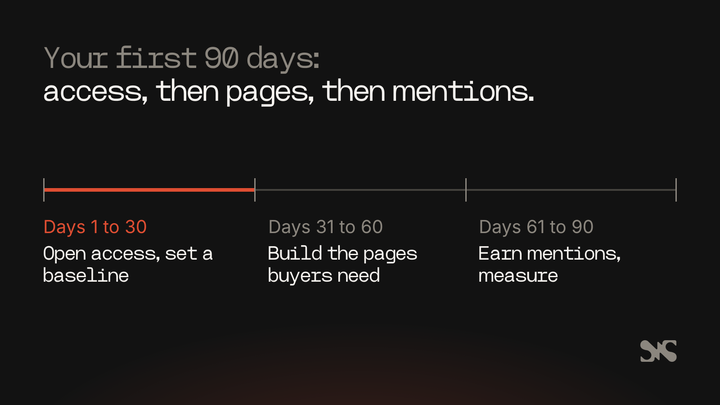
Days 1 to 30: access and baseline
- Check robots.txt and CDN rules for the search crawlers in the table above.
- Verify the site in Google Search Console and Bing Webmaster Tools.
- Set up the “AI assistants” channel group in GA4 and the free-text source field on your forms.
- Write your list of buyer prompts and record what each assistant says today.
Days 31 to 60: pages buyers ask about
- Fill the gaps: comparison, alternatives, pricing, integration and use case pages for your most common deals.
- Rewrite the top of your key pages so each section answers its heading in the first sentence.
- Add or fix Organization and SoftwareApplication structured data, matching the visible text.
Days 61 to 90: mentions and measurement
- Bring review site profiles up to date and start a steady review request routine.
- Pitch the comparison lists that rank for your category, with a fact sheet.
- Publish one piece of original research or data that the trade press can cite.
- Re-run the prompt checks and compare them with day one.
What are the most common AI search mistakes?
The most common AI search mistakes are blocking the crawlers you need, chasing tricks instead of fixing pages, and ignoring what third-party sites say about you. Each one has a simple fix.
Blocking search crawlers by accident. A blanket “block AI bots” setting at the CDN or a copied robots.txt can remove you from ChatGPT, Claude and Perplexity answers. Fix: allow the search crawlers by name and make a separate, deliberate choice about training crawlers.
Writing for robots, not buyers. Pages stuffed with question headings and repeated keywords read badly and rarely get cited. Fix: write one clear answer per question for a sceptical buyer, then check it still reads naturally aloud.
Hiding the facts. Pricing behind a form, integrations in a logo wall with no text, and security details in a PDF leave assistants to guess. Fix: put the facts on the page in plain text.
Inconsistent descriptions. Calling yourself a “platform” on the website, a “tool” on G2 and something else on LinkedIn confuses both buyers and assistants. Fix: agree one description and category and use it everywhere.
Measuring too early or too narrowly. Judging AI search on one week of referral clicks misses most of its effect, which shows up in shortlists and branded search. Fix: track citations, prompt checks, AI referrals and self-reported source together, monthly.
What should you look for in an AI search agency?
A good AI search agency for B2B SaaS treats it as SEO plus PR plus measurement, shows how it tracks citations, and doesn't promise rankings in answers it can't control. Ask any agency or consultant:
- How do you decide which buyer prompts to track, and how often do you run them?
- What will you change on our site first, and why?
- How do you earn mentions on review sites, lists and in the press?
- How will we see the effect on pipeline, not just visibility scores?
- Which of your AI search claims come from vendor documentation, and which are your own tests?
Be wary of guaranteed placement in ChatGPT or Google AI answers, secret formulas, or plans built only on mass-produced content. Google's spam policies treat many pages made mainly to manipulate rankings as scaled content abuse “no matter how it's created” (Google Search Central, 2026).
If you'd like a shortlist, we've reviewed and ranked the best AI SEO agencies for B2B SaaS, and our post on GEO for SaaS companies goes deeper on the tactics.
About SaaS Hackers
SaaS Hackers is a community and directory built by B2B SaaS marketing specialists for B2B SaaS marketers. It shares practical guides, handbook entries and templates from people who do the work, and lists hand-picked agencies and freelance experts with proven B2B SaaS experience. SaaS Hackers is run by Team 4, a B2B SaaS marketing agency that is listed and ranked in the directory.
FAQs
Some common questions, answered
What is AI search optimisation?
AI search optimisation is the work of getting your brand and product found, cited and recommended in answers from AI assistants such as ChatGPT, Google AI Overviews and AI Mode, Claude, Perplexity and Copilot. It builds on SEO and adds answer-first content, buyer-intent pages and accurate descriptions of your product on third-party sites.
Is GEO different from SEO?
Generative engine optimisation uses the same foundations as SEO: crawlable pages, helpful content and a good reputation. The difference is the goal. SEO aims for a ranking and a click, while GEO aims for a mention or citation inside an AI answer, which depends more on clear answers and on what other sites say about you.
Should a SaaS company block GPTBot and ClaudeBot?
That is a business choice. GPTBot and ClaudeBot collect content that may be used to train models, and blocking them doesn't remove you from ChatGPT or Claude search answers, which use OAI-SearchBot and Claude-SearchBot. Blocking the search crawlers is what removes you from answers, so allow those if you want to be found.
Does llms.txt help you appear in AI answers?
llms.txt is a 2024 proposal for a Markdown file that summarises a site for AI tools. It is cheap to add and useful for documentation, but none of the major AI search vendors' crawler documentation says it is used to choose citations. Treat it as an optional extra and put your effort into clear pages and access first.
How long does AI search optimisation take to work?
Access fixes can take effect within days: OpenAI and Perplexity both say robots.txt changes take around 24 hours to reach their search systems. Page rewrites follow the pace of normal crawling and indexing, usually weeks. Third-party mentions and review growth take months, so plan on a 90-day first phase and review results monthly.