








B2B SaaS SEO strategy: how to win in Google and AI search
How to plan and run a B2B SaaS SEO strategy that wins in Google's classic results and gets your product cited in AI answers, from keyword research by use case to measuring the pipeline it brings in.

Written by
SaaS Hackers- SEO
- Inbound Marketing
- Content & SEO
- Demand Generation
- GTM Strategy
- Guide

Quick answer: A SaaS SEO strategy is a plan for getting your software found, and recommended, when buyers search Google or ask an AI assistant about the problem it solves. It starts with what people already search for, puts the pages closest to a buying decision first, and measures success in demos and trials rather than traffic.
Most B2B SaaS companies don’t fail at SEO because they picked the wrong tool or forgot a meta tag. They fail because they publish for the keywords that look impressive in a deck, wait a year, and then find the traffic never turns into pipeline. Meanwhile the way people search has shifted under them: Google now answers many questions with AI Overviews and AI Mode, and a growing share of software research starts in ChatGPT, Claude or Copilot.
This guide is for founders and in-house marketers who want an SEO plan that holds up in both places. It covers how AI search has changed the job, the principles worth keeping, how to audit where you stand, keyword research by use case, the pages to build first, technical SEO for SaaS sites, links and mentions, and how to measure the result. It’s written by SaaS Hackers, the B2B SaaS marketing directory and resource, and draws on the same approach the specialists in our directory use.
What is a B2B SaaS SEO strategy?
A B2B SaaS SEO strategy is a plan for earning visibility in organic search and AI answers for the problems your software solves, ordered by how close each search sits to a purchase. It decides which searches you target, which pages answer them, how those pages get found and trusted, and how you prove the work brings in revenue.
B2B SaaS SEO differs from consumer or e-commerce SEO in four ways that change the plan.
The keyword sets are small. A niche product might have a few hundred searches a month that matter, but the people behind them are choosing software for a whole team. Several people decide, too: a marketing manager researches, a head of finance checks the price and an IT lead checks security. Each searches differently, and each needs a page.
Sales cycles are long. A visit today might become a demo in three months, so if you only measure last-click conversions, SEO always looks weak. And intent hides in the wording. “What is revenue recognition” and “revenue recognition software for SaaS” look alike in a keyword tool, but only one of them comes from a buyer.
That last point drives most of the decisions in this guide. If you’re not sure how intent works, our handbook entry on what search intent is in SEO explains it in plain terms.
How has AI search changed SaaS SEO?
AI search has added a second way to be found: being cited inside an AI-generated answer, alongside ranking as a classic blue link. The pages that earn both are the ones that answer a specific question clearly, are easy to crawl, and are backed up by what other sites say about you. Our guide to AI search optimisation for B2B SaaS goes deeper on how each assistant chooses its sources.
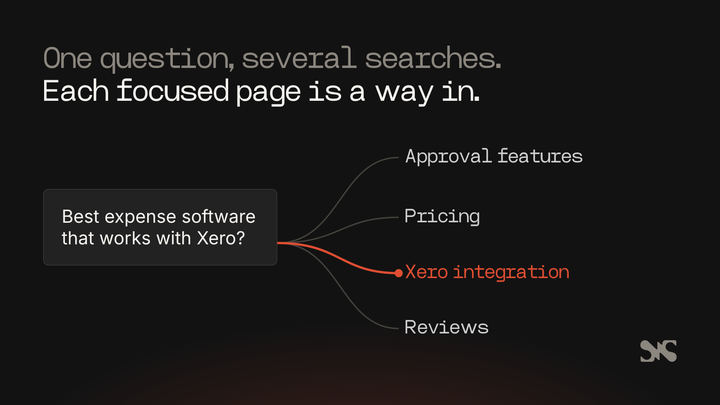
In Google, the two AI features are AI Overviews (a summary at the top of some results pages) and AI Mode (a conversational search for questions that need comparison or reasoning). Google says both may use a “query fan-out” technique, running several related searches across subtopics before writing the answer, and that they show a wider set of supporting links than a classic results page (Google Search Central, 2025). For a SaaS buyer, that means a question like “best expense software for a 50-person company that uses Xero” gets broken into smaller searches about features, pricing, integrations and reviews. Each of those is a chance for one of your pages to be cited.
AI summaries also cost clicks. Pew Research Center tracked the browsing of 900 US adults in March 2025 and found that people who saw an AI summary clicked a traditional result in 8% of visits, against 15% when no summary appeared (Pew Research Center, 2025). Clicks on the links inside the summary happened in just 1% of visits. Fewer clicks reach your site for informational questions, so the clicks that do arrive, and the citations that put your brand in front of buyers, matter more.
Google says its AI features need nothing beyond normal SEO. A page must be indexed and eligible to show with a snippet, and “there are no additional technical requirements” (Google Search Central, 2025). The same fundamentals apply: allow crawling, use internal links, keep important content in text, and make structured data match what’s visible on the page.
Outside Google, each AI assistant has its own crawler. OpenAI uses OAI-SearchBot to show sites in ChatGPT search, and sites that block it won’t appear in ChatGPT search answers (OpenAI, 2026). Anthropic separates Claude-SearchBot (search quality), Claude-User (fetching pages when someone asks Claude a question) and ClaudeBot (model training), so you can allow search access while opting out of training (Anthropic, 2026). Check your robots.txt and your CDN’s bot settings; plenty of SaaS sites block these crawlers by accident.
What people now call GEO (generative engine optimisation) or AEO (answer engine optimisation) is mostly good SEO with a sharper edge: write sections that answer one question each, open them with a sentence that stands on its own, name your product and category plainly, and get mentioned on the third-party sites AI tools trust. Our AI search guide goes deeper, and if you want outside help, we’ve ranked the best AI SEO agencies for B2B SaaS.
The principles behind a SaaS SEO strategy that lasts
The tactics change every year. These principles from the original version of this guide still hold, and they matter more now that AI answers reward clarity.
SEO captures demand; it doesn’t create it
SEO puts you in front of people who are already looking. If nobody searches for your category, SEO alone won’t build it. A brand-new category needs PR, events and paid media to create the searches that SEO can then capture. Target the problem people already search for, then introduce your category name on the page.
Keyword data is market research
Search data tells you, in buyers’ own words, what they need and how they describe it. Treat it the way you’d treat survey results. It can shape your positioning, your product pages and your sales deck, not just your blog.
Buyers looking for a product beat readers looking to learn
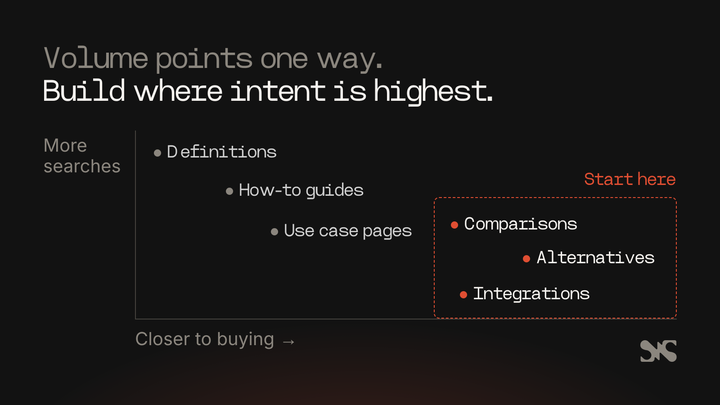
Someone searching “contract management software for SaaS” is closer to buying than someone searching “what is a contract”. Both are worth serving eventually, but the first group pays the bills. Build for them first.
Every segment searches differently
People rarely search for “accounting software”. They search for “accounting software for agencies” or “accounting software that integrates with HubSpot”. Each meaningful segment (industry, company size, role, integration) can justify its own page.
Platform or single-purpose product: know which you’re competing as
A platform such as HubSpot competes for “email marketing tools” even though it does far more, because it solves that problem too. If you’re a platform, map every job your product does and compete for each one. If you do one job, own it completely.
Either way, the companies ranking for your terms may not be the ones your sales team meets in deals. In search, your competitors are whoever holds the results page.
Good UX is good SEO
A fast, clear page that answers the question well tends to rank, convert and get cited. A slow page stuffed with keywords does none of the three.
SEO or paid search: where should a SaaS company start?
Most B2B SaaS companies need both: paid search for demand you can capture this quarter, SEO for the pages that keep bringing in buyers without a cost per click. The choice is about sequencing, not either-or.
Paid search gives you clicks on day one and sharp data on which keywords convert. SEO takes months to build, but a page that ranks keeps working when the budget stops. A sensible pattern is to run paid search on your highest-intent terms while the SEO pages are being built, then use the conversion data from paid search to decide which organic pages to prioritise. Our guide to PPC for B2B SaaS covers the paid side in detail.
How do you audit where your SaaS SEO stands today?
A SaaS SEO audit sets your starting point: what you rank for now, which pages bring in buyers, what’s broken technically, and how much of your traffic is your own brand name. Do it before you plan anything, so you can show progress later.
Work through these in order:
- Split branded from non-branded search. In Google Search Console’s Performance report, use the branded queries filter, which Google launched in November 2025 to separate searches that include your brand from those that don’t (Google Search Central, 2025). Non-branded search is the number SEO is really trying to grow. If most of your clicks are branded, people already know you and you’re not yet being found by new buyers.
- Find the pages that bring in pipeline. In Google Analytics 4, look at organic landing pages alongside your key events (demo requests, trial sign-ups). A page with modest traffic and steady demo requests is worth more than a popular glossary post.
- List your rankings and near misses. Export Search Console queries for the last few months. Queries where you sit in positions 5 to 20 are often the quickest wins, because the page already exists.
- Crawl the site. A crawler such as Screaming Frog or a tool’s site audit will show broken links, redirect chains, missing titles and pages blocked from indexing. Fix errors first; most “notices” can wait.
- Check Core Web Vitals. Search Console’s Core Web Vitals report uses real-user data. The “good” thresholds are a Largest Contentful Paint within 2.5 seconds, an Interaction to Next Paint of 200 milliseconds or less, and a Cumulative Layout Shift of 0.1 or less, measured at the 75th percentile of page loads (web.dev, 2024).
- Inventory your content. List every blog post and landing page with its traffic, conversions and the main query it ranks for. Pages that compete for the same query, or get no traffic after a year, are candidates to merge, improve or remove.
- Check AI visibility. Ask ChatGPT, Claude, Perplexity and Google AI Mode the questions your buyers ask. Note whether you’re named, which sources are cited, and which competitors appear.
How do you do keyword research for a SaaS product?
SaaS keyword research works best when it starts from what the product does, not from a seed keyword in a tool. Map the jobs, integrations and audiences first, then use search data to see which of them people actually look for.
Map use cases, integrations and audiences
List every job your software does, in plain words a buyer would use. Then list the tools it integrates with, the industries and company sizes it suits, and the competitors buyers compare you against. This becomes your research map. For a finance tool it might include “expense approvals”, “receipt capture”, “Xero integration”, “for agencies” and “alternative to [competitor]”.
Integration searches deserve special attention. People often search for a tool that works with something they already use: “email software for QuickBooks” or “QuickBooks email integration”. These searches have low volume and high intent, and many competitors ignore them.
Pull the search data
Put each item on your map into a keyword tool (Semrush, Ahrefs or similar) and Google Search Console. Collect related searches, questions and “vs” or “alternative” searches. Group them by the use case they belong to, so you end up with clusters rather than a flat list of thousands of rows.
A spreadsheet formula can speed up tagging. In Google Sheets, REGEXMATCH flags keywords that contain buying words:
=REGEXMATCH(A2, "software|tool|platform|app|pricing|alternative|vs|best|integration")
Use the same trick with your brand name to tag branded queries in older exports.
Sort by intent before volume
Volume is the least useful number in B2B SaaS. A term with 50 searches a month from people comparing products beats a term with 5,000 from students. Rank each cluster by how close it is to a buying decision, then by how much it matters to the business, then by volume and difficulty.
Map keywords to pages
Give each cluster one page. Two pages chasing the same query compete with each other (keyword cannibalisation), and AI tools may cite the weaker one. Check your existing pages first: often the best move is improving a page that already ranks on page two rather than writing a new one.
Which pages should a SaaS company build first?
Build the pages closest to a buying decision first: comparison, alternatives, integration, use case and pricing pages. They get less traffic than educational content but convert at a far higher rate, and they’re the pages AI assistants cite when someone asks which product to choose.
| Page type | What the buyer searches | What the page needs |
|---|---|---|
| Alternatives | “[competitor] alternatives” | An honest list that includes you, with who each option suits |
| Comparison | “[you] vs [competitor]” | A fair side-by-side on features, pricing model and fit |
| Integration | “[your category] for [tool]” | What the integration does, how to set it up, who it’s for |
| Use case or industry | “[category] for [industry or team]” | The problem in that buyer’s words, how the product solves it, proof |
| Pricing | “[you] pricing” | Clear plans and what’s included; hidden pricing sends people to third-party sites |
| Template or tool | “[task] template”, “[metric] calculator” | Something useful a buyer can use straight away |
Be fair on comparison and alternatives pages. Buyers check claims against review sites and the competitor’s own pages. A page that admits where a competitor is the better fit earns more trust than one that claims to win every row.
Then build educational content around these pages, so readers can move from “what is” to “which product”. That’s where topic clusters come in.
How do topic clusters and content fit into SaaS SEO?
A topic cluster is a group of pages on one subject: a broad pillar page linked to focused pages on each subtopic, all linking back. It shows search engines and AI tools that you cover a subject in depth, and it moves readers from learning to buying.
A cluster on expense management might have a pillar page on expense management for growing companies, then focused pages on approval workflows, receipt capture, policy templates and integrations, each linking to the relevant product or use case page. Internal links do the heavy lifting here. They help crawlers find new pages and tell them which pages matter most.
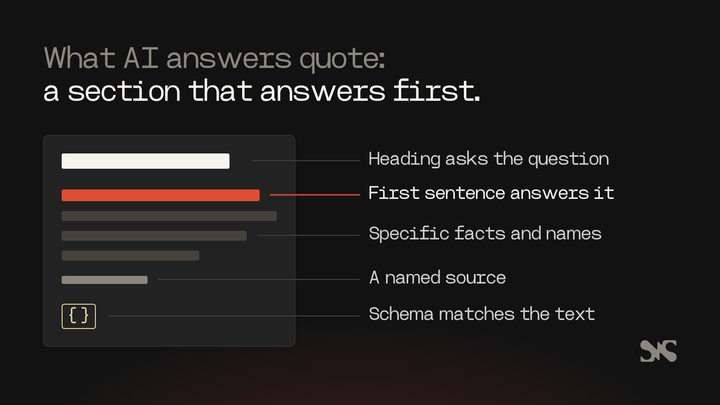
Write each section so it could be quoted on its own. AI answers lift passages, not whole pages, so a section that opens with a clear answer, uses specific numbers and names the product and category is far more likely to be cited.
AI writing tools can speed up research and first drafts, but be careful with scale. Google’s spam policies name “using generative AI tools or other similar tools to generate many pages without adding value for users” as an example of scaled content abuse (Google Search Central, 2026). The test is the same for human and AI writing: does the page add something a reader can’t get elsewhere?
Keep content alive after it’s published. Review your most important pages at least twice a year, update facts and screenshots, merge thin posts that compete with each other, and remove or redirect pages that serve no reader. Our guide to B2B SaaS content marketing covers planning, formats and distribution in detail.
Technical SEO for SaaS websites
Technical SEO makes sure search engines and AI crawlers can find, render and understand your pages. Most B2B SaaS marketing sites are small, so the work is less about scale and more about a handful of common traps.
- Crawl access for AI tools. Check robots.txt and your CDN or firewall settings for Googlebot, Bingbot, OAI-SearchBot and Claude-SearchBot. Blocking them can stop you appearing in AI answers entirely.
- JavaScript rendering. If your marketing site is a single-page app, check that headings, copy and links are in the HTML Google sees. Search Console’s URL Inspection tool shows the rendered page. Key content in text, not just in images or scripts, is one of Google’s stated basics for AI features.
- Subdomains and the app. Keep the logged-in app, staging sites and test environments out of the index. Help centres and docs on a subdomain can rank well, so link them from the main site rather than leaving them isolated.
- Site speed. Hit the Core Web Vitals thresholds above on your key templates (homepage, product, pricing, blog posts). Lighthouse in Chrome is useful for spotting problems, but Search Console’s field data is what counts.
- Structured data. Use Organization, SoftwareApplication, Article and BreadcrumbList markup where it fits, and make sure it matches the visible page. Google limited FAQ rich results to well-known government and health sites in August 2023 (Google Search Central, 2023), so add FAQ markup for clarity, not for a rich result.
- Redirects and migrations. Rebrands and CMS moves are where SaaS sites lose most rankings. Map every old URL to its new one before launch and check the redirects work afterwards.
Our post on technical SEO for SaaS platforms covers crawling, indexing and site speed in more depth.
How do you build links and mentions for a SaaS company?
Links and mentions from relevant, trusted sites tell search engines and AI tools that other people vouch for you. For SaaS, the best ones usually come from your product’s place in the market rather than from outreach volume.
Start with the links you’ve already earned but not collected. Ask every tool you integrate with to list you in its marketplace or integrations directory, with a link. Keep your profiles on G2, Capterra and similar review sites complete and current, because buyers use them to build shortlists.
Customers and partners are the next source: case studies co-published with customers, agency partner pages and conference speaker pages are natural, relevant links. Then give people a reason to cite you. Anonymised benchmarks from your product, an annual survey or a useful free tool give journalists and bloggers something worth linking to.
Where you’re mentioned matters as well as who links to you. Pew found Wikipedia, YouTube and Reddit were the most cited sources in Google’s AI summaries (Pew Research Center, 2025), which shows the kind of places AI tools draw on: community discussions, videos and reference sites. Accurate, genuine discussion of your product in those places helps, while planted posts tend to get removed and can damage trust in the brand.
Digital PR ties this together: research or stories that earn coverage and links from industry publications. Our post on how digital PR builds backlinks and traffic walks through the process.
How do you measure SaaS SEO performance?
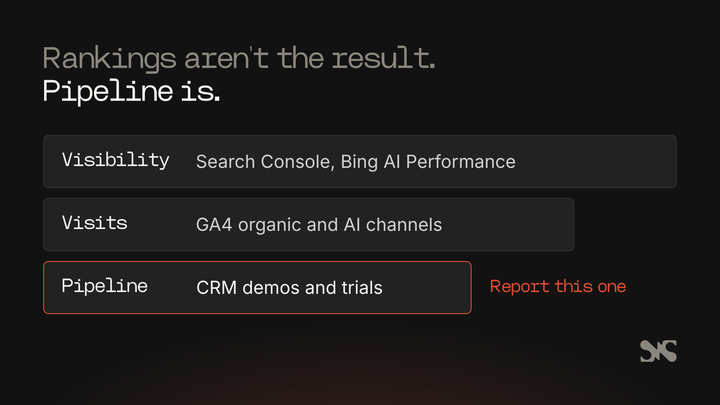
Measure SaaS SEO in three layers: visibility (are you showing up?), visits (are the right people arriving?) and pipeline (are they becoming demos, trials and customers?). Reporting only the first layer is how SEO loses its budget.
Visibility
Google Search Console is the main source. Sites that appear in AI Overviews and AI Mode are counted in the Performance report under the “Web” search type, along with the rest of Google Search (Google Search Central, 2025). Use the branded queries filter to track non-branded clicks and impressions.
For Microsoft, Bing Webmaster Tools added an AI Performance report in public preview in February 2026, showing how often your pages are cited as sources in Copilot and Bing’s AI summaries, and the queries behind those citations (Microsoft Bing, 2026). Add regular manual checks of your key buyer questions in ChatGPT, Claude and Perplexity, or a tracking tool if your budget allows.
Visits
In GA4, look at organic search sessions to your high-intent pages, not just total organic traffic. GA4’s custom channel groups let you define your own traffic categories using rules such as a regular expression on the source (Google Analytics Help, 2026), so you can group referrals from AI assistants (chatgpt.com, perplexity.ai, claude.ai, copilot.microsoft.com) into one channel and watch it grow.
Pipeline
Pass the first-touch and last-touch source into your CRM with every form fill, then report organic-sourced demos, trials, opportunities and revenue. Expect a lag: B2B SEO often shows up in pipeline months after the rankings move. Agree that timeline with your leadership team at the start.
Common SaaS SEO challenges and how to solve them
“We get traffic but no demos.” The traffic is going to educational pages that don’t link anywhere useful. Add clear next steps from those pages to use case and comparison pages, and shift new work towards bottom-of-funnel content.
“Our category is new, so nobody searches for it.” Target the problem and the old way of solving it, which people do search for. Introduce your category term on those pages and support it with PR so the category searches grow over time.
“AI answers name our competitors, not us.” Check that AI crawlers can reach your site, then look at which sources the answers cite. Usually the fix is clearer comparison and use case pages on your own site plus accurate, current profiles on the review sites being quoted.
“Our blog is huge and traffic is falling.” Too many thin or overlapping posts dilute a site. Merge posts that target the same query, update the ones that bring in buyers, and redirect or remove the rest.
“Leadership wants results in a quarter.” Run paid search on high-intent terms for quick wins, and agree on leading indicators for SEO (non-branded impressions, rankings for priority pages, AI citations) while pipeline builds.
What to look for in a SaaS SEO agency or consultant
If you bring in outside help, look for evidence of results with B2B SaaS companies at your stage, measured in pipeline rather than traffic. Ask how they approach AI search and what they’d change about your site in the first 90 days. Check that they’ll work from your product’s use cases and your sales team’s knowledge, not a generic keyword list, and ask who will actually do the work. Be wary of anyone who guarantees rankings or offers to publish hundreds of pages a month.
About SaaS Hackers
SaaS Hackers is a curated directory and resource for B2B SaaS marketers and founders, built by marketers, operators and product specialists who do the work. It lists hand-picked agencies and freelancers with proven experience in B2B SaaS digital marketing, alongside practical guides and ranked top lists.
To compare specialists who can run this strategy for you, see our ranked list of the best B2B SaaS SEO agencies.
FAQs
Some common questions, answered
What is SaaS SEO?
SaaS SEO is search engine optimisation for software companies. It aims to get a SaaS product found in Google’s results and AI answers by people searching for the problems it solves. It focuses on high-intent searches such as comparisons, alternatives and integrations, and it measures success in demos, trials and revenue rather than traffic alone.
How long does SaaS SEO take to work?
Expect early movement in rankings and impressions within a few months for pages targeting low-competition, high-intent terms, and longer for competitive terms. Pipeline usually lags behind rankings because B2B sales cycles are long. Agree leading indicators, such as non-branded impressions and AI citations, so progress is visible while revenue builds.
Do I need a separate strategy for AI search?
Not a separate one, but an extended one. Google says AI Overviews and AI Mode have no extra technical requirements beyond being indexed and eligible for a snippet. The additions are making sure AI crawlers can reach your site, writing sections that answer one question clearly, and being described accurately on the third-party sites AI tools cite.
Which SEO pages convert best for B2B SaaS?
Pages closest to a buying decision usually convert best: alternatives pages, head-to-head comparisons, integration pages, use case or industry pages and a clear pricing page. They attract fewer visitors than educational posts, but the people who land on them are actively choosing a product, so a higher share request a demo or start a trial.
Should SaaS companies block AI crawlers?
Blocking search crawlers such as OAI-SearchBot or Claude-SearchBot can stop your pages appearing in those assistants’ answers. Most SaaS companies want that visibility, so allow the search crawlers. If you don’t want your content used to train models, both OpenAI and Anthropic let you block their training crawlers separately while still allowing search.