








Revenue operations for B2B SaaS: how to build a RevOps function the whole company trusts
Revenue operations joins marketing, sales, customer success and finance into one revenue system with shared definitions, data and reporting. This guide covers what RevOps does in a B2B SaaS company, the metrics it owns, how AI is changing the work, and a phased plan to set it up.

Written by
SaaS Hackers- Revenue Operations
- Revenue Operations & Data
- Guide

Quick answer: Revenue operations (RevOps) is the function that runs marketing, sales, customer success and the revenue side of finance as one system, with one set of stage definitions, one source of customer data and one set of revenue metrics. In a B2B SaaS company it exists to make the number predictable: a forecast the board believes and a cost of growth that you can see and control.
Most SaaS companies don't decide to “do RevOps”. They arrive at it after the third meeting where marketing, sales and finance bring three different pipeline numbers and nobody can say which is right. The CRM has grown by accident, and renewals live in a spreadsheet on someone's laptop.
This guide is for founders, revenue leaders and marketing leaders at B2B SaaS companies who want to fix that properly. It covers what revenue operations is, how it differs from sales ops and marketing ops, the four pillars, the metrics RevOps should own, forecasting, pricing, how to build the team, how AI is changing the work, and a phased plan to set it up without stopping the business to rebuild everything.
What is revenue operations?
Revenue operations is the operating function that designs and runs the whole revenue process, from the first marketing touch to the renewal, as one connected system. It owns the shared parts that no single go-to-market team owns on its own: the lifecycle stages, the CRM and its data, the hand-offs between teams, and the reporting everyone works from.
That gives RevOps two jobs. The first is design: deciding what the revenue engine should look like, which stages a deal and a customer move through, what each stage means, who owns it and what has to be true before it moves on. The second is running it: CRM administration, integrations, data quality, reporting, forecasting support and helping the people who use the systems every day.
The scope is the whole revenue cycle. The core is marketing, sales and customer success, but RevOps also reaches finance (billing, bookings and ARR), product (pricing, packaging and usage data) and sometimes legal (contract terms that affect renewals). In a SaaS business, where most of the value of a customer arrives after the first contract, that last part matters as much as new business.
Why do B2B SaaS companies adopt RevOps?
B2B SaaS companies adopt RevOps because recurring revenue only compounds when acquisition, retention and expansion are run as one process. A subscription business can't hit its number on new logos alone if customers quietly leave at renewal, and it can't forecast renewals if customer success data never reaches the CRM.
Retention is the clearest example. SaaS Capital's 2025 survey of private B2B SaaS companies found that companies with net revenue retention of 110% or more grew faster than the survey median of 24%, and companies below 100% grew more slowly (SaaS Capital, 2025). Retention is not something customer success can fix on its own. It depends on which customers marketing attracts, what sales promised them, how onboarding went and whether anyone saw the warning signs in the product data.
The other reason is cost. Benchmarkit's 2025 benchmarks put the median new CAC ratio at $2.00 of sales and marketing spend for every $1.00 of new customer ARR in 2024, up 14% on the year before (Benchmarkit, 2025). When new revenue costs that much, a company needs to see exactly where pipeline leaks, which channels bring customers who stay, and where expansion is cheaper than acquisition. That needs joined-up data, which is what RevOps provides.
How is RevOps different from sales ops and marketing ops?
Sales ops and marketing ops each optimize one team; RevOps optimizes the system those teams share. The functional ops roles still exist inside or alongside RevOps, but the decisions that cross team lines move to one owner.
| Area | Marketing ops | Sales ops | Revenue operations |
|---|---|---|---|
| Main goal | Efficient demand and lead flow | Productive sellers and a clean pipeline | Predictable revenue across the lifecycle |
| Owns | Marketing automation, campaign data, lead scoring | CRM for sales, territories, quotas, pipeline reporting | Lifecycle stages, CRM as a whole, cross-team reporting, forecasting process |
| Measured on | MQLs, cost per lead, conversion to opportunity | Pipeline, win rate, quota attainment | ARR growth, net revenue retention, CAC payback, forecast accuracy |
| Typical blind spot | What happens after the lead is passed on | What happens after the deal closes | Rarely the detail of a single team's tools |
Marketing ops is still where most of the marketing automation, tracking and campaign data work happens. Our guide to B2B SaaS marketing operations covers that in detail. The point of RevOps is that the definition of a qualified lead, an opportunity and a healthy customer is agreed once, by everyone, and built into the systems.
The four pillars of RevOps: process, data, technology and insight
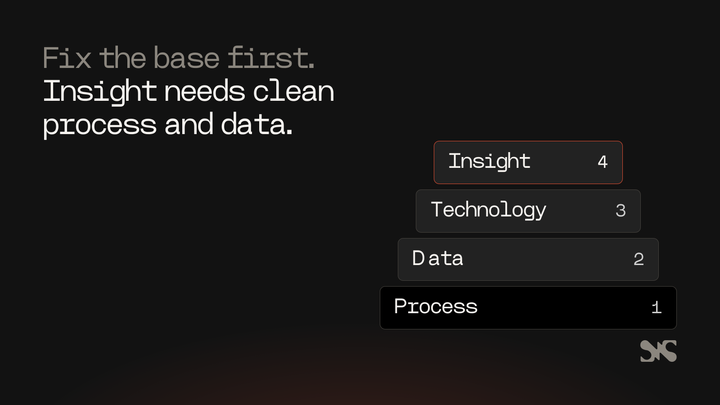
A working RevOps function rests on four pillars: process, data, technology and insight. Each one depends on the one beneath it. Dashboards built on unclear stages report nonsense, and new tools bolted onto dirty data spread the mess faster.
Process
Process is the agreed path a buyer and a customer take through the company: lifecycle stages, deal stages, entry and exit criteria for each, service levels for follow-up, and who owns the record at each point. Write it down. If a new account executive or a new marketer can't read one page and know what “sales qualified” means in your business, the process isn't defined yet.
Data
Data is the shared record that process runs on. That means one account and contact model, consistent required fields, rules for creating and merging records, and a data owner for each object. Most RevOps projects spend more time here than anywhere else, and it's time well spent.
Technology
Technology is the stack that holds the process and the data: the CRM, marketing automation, sales engagement, billing, product analytics and the integrations between them. The RevOps job is to keep it as small and connected as the business allows, and to make sure every tool writes back to the CRM rather than keeping its own version of the truth.
Insight
Insight is the reporting, analysis and forecasting that the other three pillars make possible. Good insight answers questions leaders actually ask: where is the pipeline coming from, where does it stall, which customers are at risk, and are we going to hit the quarter. It also separates the numbers worth reporting to the board from the ones that only look good, a distinction our handbook entry on vanity metrics vs pipeline metrics explains well.
How RevOps covers the full customer lifecycle
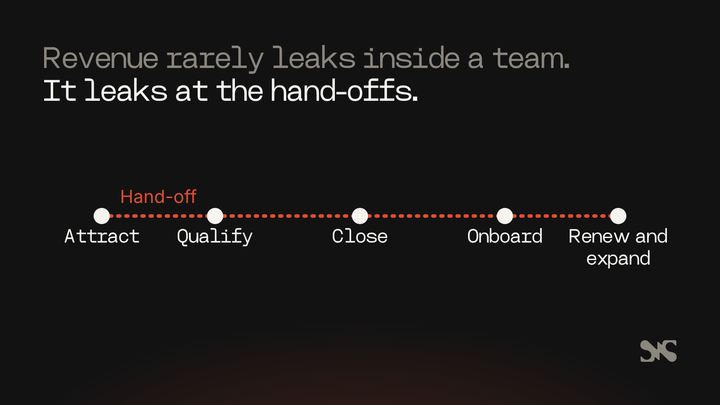
RevOps treats the customer lifecycle as one route with five hand-offs, and makes sure no record, promise or signal gets dropped at any of them. Most revenue leaks happen at the hand-offs, not inside the teams.
Marketing to sales
The first hand-off is from marketing to sales. RevOps agrees what makes a lead ready for a salesperson, how fast sales must follow up, and what happens to leads sales rejects (they should go back to nurture with a reason, not disappear). Lead scoring, routing rules and a shared definition of a qualified opportunity all live here.
Sales: from opportunity to closed deal
Inside sales, RevOps owns the deal stages, the exit criteria for each, the required fields that make forecasting possible (amount, close date, next step, decision process) and the pipeline reviews that use them. Whether your motion is sales-led, product-led or a mix changes where the hand-offs sit. Our handbook entry on sales-led vs product-led go-to-market covers how that choice shapes the process.
Sales to customer success
The hand-off from sales to customer success is where many SaaS companies lose the plot. The account executive knows why the customer bought, what was promised and who the champion is, and that knowledge often stays in their head. RevOps builds a closing hand-off into the deal stage itself: success criteria, key contacts and agreed milestones captured on the record before the deal can move to closed won.
Customer success, renewal and expansion
After onboarding, RevOps gives customer success the same discipline sales has: a health score built from real signals (product usage, support tickets, engagement, invoice status), renewal stages with dates and owners, and expansion opportunities tracked in the same CRM as new business. Renewals forecast from the CRM are far more reliable than renewals forecast from memory.
Finance
Finance closes the loop. Bookings, invoices and ARR need to match what the CRM says, and the definitions behind them (when a deal counts as new, expansion or renewal) need to be the same in both places. When RevOps and finance agree those rules, board reporting stops being a monthly reconciliation exercise.
Systems: the CRM as the single source of truth
The CRM is the backbone of revenue operations: every team works from it, and every other tool writes back to it. It doesn't matter much whether that CRM is HubSpot, Salesforce or something else. It matters that there is only one, and that its version of an account, a deal and a customer is the one everyone uses.
In practice that means a few firm rules:
- One record per company and per person, with agreed rules for creating, matching and merging records.
- Required fields at each stage, so a deal can't move on without what the next team and the forecast need.
- Every other tool (marketing automation, sales engagement, billing, support, product analytics) lives inside the CRM or syncs back to it.
- New fields, stages and workflows go through RevOps, with a note of why they exist and who owns them.
If your business runs on HubSpot, the agencies on our list of B2B SaaS HubSpot agencies work on exactly this kind of CRM set-up and clean-up.
Integration
Integrations are where good intentions go to break. Every sync between two systems needs an owner, a direction (which system wins when they disagree), a field map and monitoring so someone knows when it fails. Keep a simple integration register: what connects to what, which fields move, how often, and who to call when it stops.
Data quality and governance
Data quality is not a one-off clean-up. Set a small number of measures you check every month, such as the share of open deals with a close date in the past, contacts without an owner, accounts without an industry or size, and duplicate records created this month. Publish them. When the numbers are visible, the teams that create the data start to care about it.
Governance also covers privacy. RevOps should know where personal data sits, which tools process it and how consent is recorded, working with whoever owns data protection.
Which SaaS metrics should RevOps own?
RevOps should own the definitions and the reporting of the metrics that span teams: ARR, net and gross revenue retention, pipeline coverage, win rate, sales cycle length and CAC payback. Each team still owns improving its part. RevOps makes sure everyone calculates them the same way.
| Metric | What it measures | How to calculate it |
|---|---|---|
| ARR (annual recurring revenue) | The yearly value of active subscriptions | Sum of active recurring contract value, annualized, excluding one-off fees |
| Net revenue retention (NRR) | Revenue kept and grown from an existing customer group | Recurring revenue now from customers you had a year ago, divided by their recurring revenue a year ago |
| Gross revenue retention (GRR) | Revenue kept, ignoring growth | As NRR, but each customer's revenue is capped at its starting level, so it can't exceed 100% |
| Pipeline coverage | Whether there is enough pipeline to hit the target | Open qualified pipeline for the period divided by the remaining target |
| Win rate | How often qualified deals close | Deals won divided by deals closed (won plus lost) in a period |
| Sales cycle length | How long deals take | Average days from opportunity created to closed won |
| CAC payback | How long it takes to earn back acquisition cost | Sales and marketing cost to win new customers, divided by their monthly recurring gross margin |
Two of these need care. Net revenue retention is the strongest single sign of a healthy SaaS business, and our handbook explains what net revenue retention is and how investors read it. Pipeline coverage only means something next to your own win rate: if you win a quarter of qualified deals, you need roughly four times the remaining target in qualified pipeline. A “standard” coverage ratio borrowed from another company tells you very little.
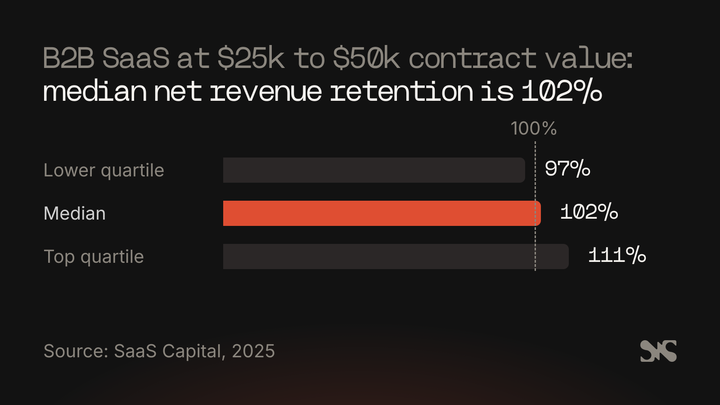
Benchmarks help you see where you stand, as long as you compare like with like. SaaS Capital's 2025 data shows that net retention rises with contract value.
For private B2B SaaS companies with annual contract values between $25,000 and $50,000, median NRR was 102%, with the top quartile at 111% and the lowest quartile at 97% (SaaS Capital, 2025). Benchmarkit reports that median gross revenue retention slipped from 90% to 88% over the three years to 2024 (Benchmarkit, 2025). For more reference points on churn, MRR and acquisition cost, see our roundup of B2B SaaS benchmarks.
How does RevOps improve forecasting?
RevOps improves forecasting by making the forecast come from the CRM, with agreed stage definitions and a fixed weekly rhythm, rather than from each manager's judgment. Accurate forecasts are a by-product of clean process and clean data, not of a better spreadsheet.
A forecast process that works usually has four parts:
- Categories everyone understands. Most teams use something like commit, best case and pipeline. Define each one in writing, with the evidence a deal needs to sit in it.
- A weekly cadence. Reps update their deals by a set time, managers review and call their number, and the revenue leader calls the company number. Every change is recorded.
- Three views compared. The rep's call, the manager's call and a view based on history (stage-weighted pipeline or past conversion rates). When they disagree, the gap is the conversation worth having.
- Renewals and expansion in the same forecast. For a SaaS business, the renewal book often carries more of next quarter's revenue than new business. Forecast it with the same discipline.
Track forecast accuracy itself. Compare what you called at the start of each quarter with what closed, by team, segment and deal size. Teams that are always optimistic, or deals that always slip, show where the process needs work.
What role does RevOps play in pricing and packaging?
RevOps doesn't usually set prices, but it supplies the evidence that pricing decisions need and builds the systems that make a price change work. Pricing in SaaS is a revenue decision that touches product, sales, finance and customer success at once, which puts RevOps in the middle of it.
The evidence includes discount levels by segment and rep, win rates by plan and price point, the limits that trigger upgrades, and the reasons customers give when they downgrade or leave. Most of it sits in the CRM already, if the right fields exist.
The systems side matters just as much. A new plan or price needs new products and price books in the CRM, updated quote templates, billing changes, approval rules for discounts and clear guidance for the sales team. When those pieces are missed, a sensible pricing change turns into months of inconsistent quotes and invoices that don't match contracts.
How do you build a RevOps team?
Most B2B SaaS companies start RevOps with one experienced generalist, reporting to the most senior revenue leader, and add specialists as the systems and team grow.
The first hire
The first RevOps person needs to be comfortable with both the business and the systems. They should be able to sit with the head of sales to agree deal stages in the morning and build the workflows that enforce them in the afternoon. Look for someone who has owned a CRM in a subscription business, understands SaaS metrics, and can explain a data problem to a non-technical leader without losing them.
Avoid hiring a pure administrator as your only RevOps person. The CRM will run, but nobody will design the revenue process.
Who RevOps should report to
RevOps works best when it reports to someone who owns the whole revenue number, such as a chief revenue officer, chief operating officer or, in a smaller company, the CEO. Reporting into sales alone tends to pull RevOps toward sales tooling and away from marketing and retention. Reporting into finance can work if the finance leader is close to go-to-market, but the risk is a function that reports on revenue without shaping how it's won.
Fractional, agency or full time
Many SaaS companies don't need a full-time RevOps team at first. A fractional RevOps lead or a specialist agency can design the process, fix the CRM and set up reporting, then hand over to an internal administrator. That suits companies that need senior thinking for a few days a week or a defined project, and our post on how a RevOps agency can help a SaaS company covers when that makes sense.
| Option | Works best when | Watch out for |
|---|---|---|
| Fractional RevOps lead | You need senior design work but not a full-time role yet | Limited hours for day-to-day support and user questions |
| RevOps agency or consultancy | You have a defined project such as a CRM migration, clean-up or new forecasting process | Knowledge leaving with them unless they document and hand over |
| Full-time hire | Several teams use the CRM daily and the stack is changing often | Hiring an administrator when you need a designer, or the reverse |
As the company grows, the team usually adds specialists in systems, analytics and deal desk, in whatever order the business hurts most.
A phased roadmap to set up RevOps
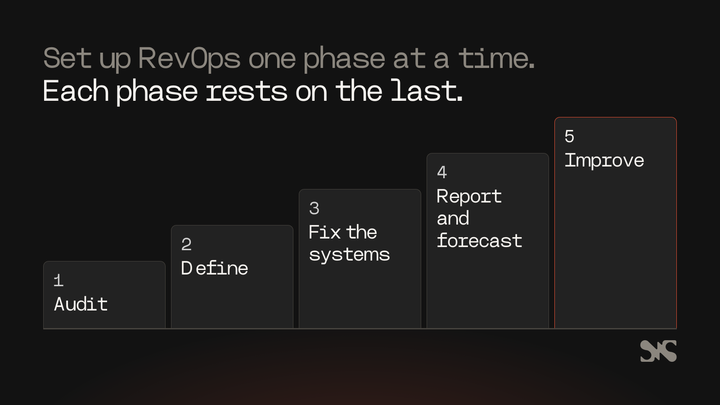
The safest way to set up revenue operations is in five phases, each finished before the next starts: audit, define, fix the systems, report, then improve. Trying to buy new tools and redesign every process at once is the most common reason RevOps projects stall.
Phase 1: audit what you have
List every system that holds customer or revenue data, every integration between them, and every report leaders use. Interview each go-to-market team about what slows them down. Pull a sample of records and check how complete and consistent they are. The output is a short, honest document of what works, what doesn't and what's missing.
Phase 2: agree the definitions
Get marketing, sales, customer success and finance in a room and agree the lifecycle stages, deal stages, exit criteria, hand-off rules and metric definitions. Write them down in one place. This phase is mostly conversation and it takes longer than people expect, because it surfaces disagreements that have been hidden for years.
Phase 3: fix the systems
Now rebuild the CRM around those definitions. Clean and merge records, add or retire fields, rebuild stages and workflows, fix the integrations and set up data quality checks. If a new tool is needed, this is when to choose it, against requirements you now understand.
Phase 4: report and forecast
Build a small set of shared dashboards from the cleaned data: pipeline by source and stage, conversion between stages, retention and expansion, and the forecast. Start the weekly forecast rhythm. Retire the old spreadsheets and reports that compete with the new ones, or people will keep using them.
Phase 5: improve continuously
Once the basics hold, RevOps moves to improvement: finding the stage with the worst conversion and testing a fix, tightening the sales to customer success hand-off, refining the health score, or reviewing pricing evidence. Hold a monthly review of data quality and a quarterly review of the process itself.
How is AI changing revenue operations?
AI is moving RevOps work from building reports to building the data and systems that AI agents depend on. The more agents a company deploys across sales and customer success, the more the quality of its CRM data and processes decides whether those agents help or just create more activity.
Gartner predicts that by 2028 AI agents will outnumber sellers by ten to one, yet fewer than 40% of sellers will say the agents improved their productivity (Gartner, 2026). The same research predicts that sales leaders who overhaul data, automation and user experience will be five times more likely to gain a return from AI than those who choose quick fixes. As Gartner's Dan Gottlieb put it: “If those systems are fragmented, the agents will scale the fragmentation.”
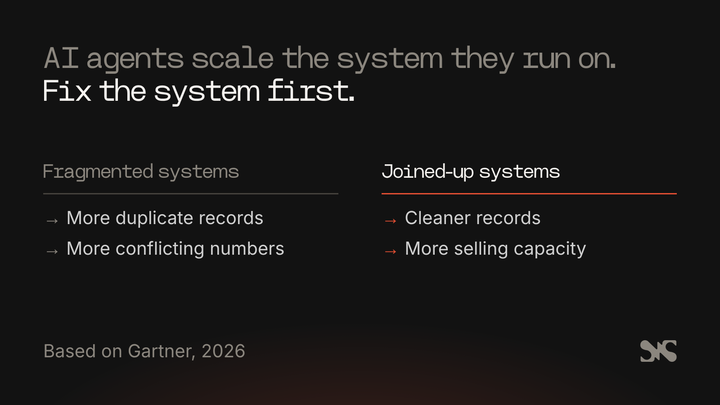
That is a RevOps job description. CRM vendors are building agents straight into the record. HubSpot's data agent, for example, tracks more than 40 live buyer intent signals, lets teams set custom account triggers such as a funding round or a new office, and writes research from calls, emails and deal history directly to the CRM record (HubSpot, 2026). Tools like this are only as useful as the account model, the field definitions and the permissions behind them.
In practice, data upkeep moves from manual work to supervision. Enrichment, deduplication and call summaries can be automated, but someone still defines the fields, checks the output and decides what the system may change. RevOps also sets the guardrails: which agents can write to which records, what they can send to customers and how their work is logged.
Reporting gets easier to ask for, because leaders can query the CRM in plain language. That makes consistent definitions more important, not less, since two people asking the same question should get the same answer. And measurement shifts. Time saved is the easy number to quote; the useful one is whether pipeline, win rates or retention moved.
Common RevOps mistakes and how to avoid them
Most RevOps failures come from doing the right things in the wrong order. These are the patterns that come up again and again.
- Buying tools before agreeing the process. A new platform doesn't fix unclear stages. Agree the definitions first, then choose tools against them.
- Treating RevOps as CRM admin. If the RevOps team only takes tickets, nobody is designing the revenue process. Give the function a seat in planning and a remit to change how teams work together.
- Leaving customer success out. RevOps that stops at closed won misses the renewal and expansion revenue that drives SaaS growth. Bring customer success data into the CRM from the start.
- Building too many dashboards. Twenty reports that nobody trusts are worse than five that everyone uses. Start small and retire the old ones.
- Changing definitions quietly. When the meaning of a stage or metric changes, historical reports stop being comparable. Log every change with a date and the reason.
- Skipping the finance hand-shake. If CRM bookings and finance's ARR never match, the board will believe finance. Agree the rules together and reconcile monthly.
What to look for in a RevOps consultant or agency
The right RevOps partner for a SaaS company has run your CRM in a subscription business, starts with process rather than tools, and leaves your team able to run what they build. Ask to see how they handle the definition work, not only the technical build.
Useful questions to ask before you sign:
- Which CRM and billing systems have you worked with in SaaS companies of our size and motion?
- How do you run the discovery and definition phase, and who from our side needs to be involved?
- How do you handle renewals, expansion and customer success data, not just new business?
- What will you document, and how will you hand over to our team?
- How will we measure whether the work improved forecast accuracy, conversion or retention?
If you'd like a shortlist, you can compare RevOps consultants and agencies for B2B SaaS in the SaaS Hackers directory, each scored on our published criteria.
About SaaS Hackers
SaaS Hackers is a community and directory built by B2B SaaS marketing specialists for B2B SaaS marketers. It shares practical guides, handbook entries and templates from people who do the work, and lists hand-picked agencies and freelance experts with proven B2B SaaS experience. SaaS Hackers is run by Team 4, a B2B SaaS marketing agency that is listed and ranked in the directory.
FAQs
Some common questions, answered
What does RevOps mean?
RevOps is short for revenue operations. It is the function that runs marketing, sales, customer success and the revenue side of finance as one system, with shared stage definitions, one source of customer data in the CRM and one set of revenue metrics. Its aim is predictable revenue growth and a forecast the whole leadership team trusts.
When should a SaaS company start RevOps?
Start when more than one team relies on the CRM and the numbers start to disagree, for example when marketing, sales and finance report different pipeline or ARR figures. For many SaaS companies that happens soon after the first sales hires. A fractional lead or a specialist agency can set up the foundations before a full-time hire is justified.
What is the difference between RevOps and sales operations?
Sales operations supports the sales team: territories, quotas, the sales pipeline and sales tools. Revenue operations covers the whole lifecycle, from the first marketing touch to renewal and expansion, and owns the definitions and data that marketing, sales, customer success and finance share. Sales ops often becomes one part of a RevOps team.
Which metrics should a RevOps team report on?
The core set is ARR, net revenue retention, gross revenue retention, pipeline coverage, win rate, sales cycle length and CAC payback, plus forecast accuracy. RevOps owns how each one is defined and calculated, so every team works from the same numbers. Each go-to-market team then owns improving the parts of those metrics it controls.
Who should RevOps report to?
RevOps works best reporting to the leader who owns the whole revenue number, such as a chief revenue officer, chief operating officer or, in a smaller company, the CEO. Reporting into sales alone tends to narrow its focus to sales tools, while reporting into a leader across marketing, sales and customer success keeps the whole lifecycle in view.