








How to choose a B2B SaaS marketing agency
There is no best B2B SaaS marketing agency, only the one suited to your stage, go-to-market motion, budget and the gap you need filled. This guide gives founders and marketing leaders a practical way to find that fit.

Written by
SaaS Hackers- Finding an Expert
- Guide

Quick answer: If you're working out how to choose a B2B SaaS marketing agency, start with a one-page brief: your stage, go-to-market motion, budget and the gap you're hiring for. Then shortlist three to five agencies whose proven niche matches that brief. Test their case studies and AI search claims, ask who will do the work, and decide on fit rather than on who pitched best.
Most people start the search for a B2B SaaS marketing agency by asking the wrong question. They ask who is the best. The honest answer is that no such agency exists.
A team that grew a product-led developer tool through self-serve sign-ups may be exactly the wrong choice for a sales-led compliance platform selling large annual contracts to enterprise buyers. Both agencies can be excellent. Only one of them fits you.
This guide is for founders and in-house marketing leaders choosing an agency for a B2B SaaS company. It covers how to define what you need before you look at a shortlist, how to match an agency to your stage and go-to-market motion, how to read case studies and AI search claims without being fooled by them, and the questions that separate a good fit from an expensive mistake.
Why is there no best B2B SaaS marketing agency?
There is no best B2B SaaS marketing agency because the work is too specialized for one team to lead across every model, stage and channel at once. B2B SaaS isn't one market. A seed-stage startup, a sales-led platform after its Series B and a bootstrapped vertical SaaS all need different things, and the skills that win in one rarely transfer cleanly to another.
Think about the range hiding inside the phrase “B2B SaaS marketing”. It covers technical SEO for a documentation-heavy developer tool, demand generation for a sales-led product with a long buying cycle, account-based marketing aimed at a short list of named accounts, product-led growth loops, category creation for something buyers don't yet search for, and paid acquisition where the math only works above a certain contract value. An agency claiming senior depth across all of these is usually a generalist stretched thin.
The market is full of strong agencies and independent experts. The hard part is matching. When a search feels frustrating, it's almost never because there are no good options. It's because you're comparing agencies against each other rather than against your own requirements.
So the useful question is who suits a company at your stage, with your go-to-market motion, your budget and your specific gap. That reframing does most of the work.
Start with your requirements, not the agency's pitch
Define what you need before you look at a single agency. The most common selection mistake is letting polished pitches shape your criteria, so you end up wanting whatever the most impressive agency happens to sell.
Write down your answers to these before you take a call. A one-page brief, such as our agency briefing template, keeps them in one place and gives every agency the same starting point.
- Stage and traction. Seed, Series A, Series B or later. Current ARR and growth rate. What is working already and what has stalled.
- Go-to-market motion. Product-led, sales-led or a hybrid. This single factor rules more agencies in or out than any other.
- The gap you're hiring for. A pipeline problem, a brand and category problem, a channel you can't staff in-house, or a lack of senior strategy to direct existing work? “We need more leads” and “our brand is invisible in a new category” call for very different partners.
- In-house capability. What your team already does well. You're buying a complement to that team, not a replacement for thinking you should own.
- Budget, honestly. The real monthly or project number. A good agency will tell you quickly whether your budget matches your goals, and that candor is a good sign.
- Timeline and success. What has to be true in six months for this to have been worth it, and how you'll measure it.
A shortlist built from these answers looks nothing like one built from rankings alone. Use rankings to check credibility and your own requirements to judge fit.
How do you match an agency to your stage and go-to-market motion?
Match the agency to your go-to-market motion and stage first, because a mismatch here undoes even excellent execution. An agency's track record only counts if it was earned in conditions that resemble yours.
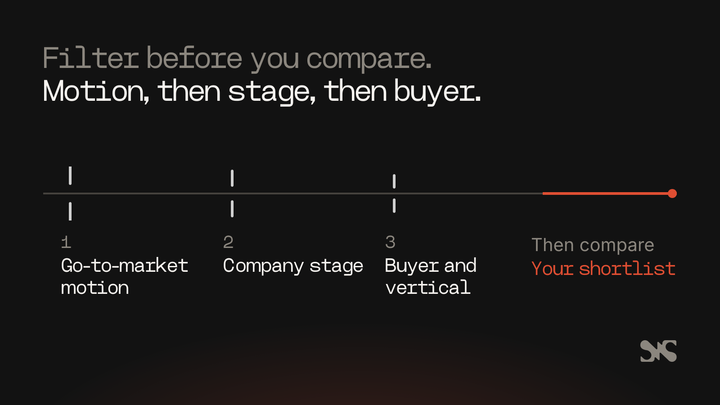
Go-to-market motion is the strongest filter. Product-led growth lives on activation, onboarding, in-product signals and self-serve conversion. Sales-led growth lives on demand generation, sales enablement, longer content and a clean handover to sales, and account-based marketing on tight targeting of named accounts and coordinated plays across channels. Ask which motion an agency has delivered, repeatedly, with results you can check.
Stage matters almost as much. A seed-stage company usually needs help finding and proving one repeatable channel on a small budget. A Series B company needs to scale channels that already work, add rigor, and often build brand and category presence ahead of the next raise.
An agency that thrives in scrappy early-stage work may struggle with the process and reporting a later-stage company expects, and the reverse is just as true. SaaS Hackers keeps ranked agency lists by stage, sector and service for exactly this reason.
Vertical and buyer type is the third filter. Selling to developers isn't the same as selling to CFOs, CISOs or heads of HR. Knowing the audience shortens the ramp-up and sharpens the messaging. It isn't always essential, but when a buyer is technical or a category is complex, an agency that already understands them earns its fee faster.
Specialist, generalist or full-service: which do you need?
Choose between a specialist, a generalist and a full-service agency based on how well defined your problem is and how much coordination you want to own. Each model suits a different situation.
A specialist goes deep on one channel or discipline: technical SEO, paid media, lifecycle, content or AI search. Choose one when you have a clearly defined gap and an in-house lead or another partner to join the work up. You get depth and accountability in that lane, and you take on the job of connecting it to everything else.
A generalist or small full-service agency covers several disciplines at a shallower depth. Choose one when your need is broad, your team is thin, and you want a single partner to own marketing end to end. You gain coordination and one point of contact, and you accept that no single discipline will go as deep as a specialist's.
A fractional leader, such as a fractional CMO or head of growth, brings senior direction part-time. Choose this when you have people or partners to do the work but lack the senior strategy to point them. Watch for a fractional leader who only advises and leaves no delivery underneath, so nothing ships.
Be skeptical of any small agency claiming senior depth across SEO, paid, content, brand, CRO and analytics at once. Someone in that mix is a competent all-rounder billed as an expert. That's fine if you need an all-rounder. It's a problem if you're paying specialist rates for it.
How do you read an agency's case studies and claims?
Read every agency case study assuming it shows the best result the agency has ever produced, because that's what a case study is. Case studies are marketing, not evidence, and a few patterns will mislead you if you take the numbers at face value.
Watch for survivorship bias. Every agency shows its wins and none of its churned accounts. A wall of logos tells you who signed, not who stayed or who succeeded. Ask how many clients they worked with over the same period, what their retention is like, and whether you can speak to a client who left.
Discount vanity metrics. Traffic, impressions, rankings and raw lead counts always go up and rarely tie to revenue. A big percentage jump in traffic means little without knowing what happened to qualified pipeline and closed revenue. Ask for the result in the currency your board cares about.
Question the counterfactual. An agency being present while a company grew isn't proof the agency caused the growth. A product launch, a funding round or the founder's own network often run alongside. Ask what they did, and what connects their work to the outcome rather than to everything else happening at the time.
Separate founder magic from repeatable systems. Early SaaS growth is often the founder's network, timing or one big logo, none of which an agency can reproduce for you. Ask which parts of the story were systematized and which were one-off circumstances.
None of this makes case studies worthless. Read them as claims to check, and notice which agencies welcome the scrutiny.
How do you judge an agency's AI search and AI tooling claims?
Judge AI search claims against Google's own guidance, because most “GEO” and “AEO” promises rest on the same foundations as good SEO. Google says that while specific optimization isn't required for AI Overviews and AI Mode, existing SEO fundamentals still apply, and a page only needs to be indexed and eligible for a snippet to be shown as a supporting link (Google Search Central, 2025).
That gives you a simple test. Ask an agency what it would do differently for AI search, and listen for crawlable pages, clear answers in text, internal links, structured data that matches the page, and content people trust. Our B2B SaaS SEO strategy guide covers how that work fits together.
Be wary of secret techniques, “AI rankings” nobody can check, or reporting that can't show where the traffic went. Google's own advice on hiring an SEO now asks whether an agency's GEO or AEO advice lines up with its official guidance, and whether the agency cites Google's documentation for its recommendations (Google Search Central, 2026).
Ask how they'll measure it, too. Google reports clicks and impressions from AI Overviews and AI Mode inside the Search Console Performance report, under the Web search type, as part of overall search traffic (Google Search Central, 2025). An agency should explain what it can measure there and in your analytics, and be plain about what it can't.
AI tooling inside the agency matters as much as AI search. Ask:
- Where does AI speed up the work, and where does a person check it? Drafts, research and reporting are fair game. Facts, claims about your product and anything published under your name need a named person to sign them off.
- What happens to your data? Ask which tools see your customer lists, analytics or call recordings, and whether anything you share is used to train a model.
- What does the saving mean for you? If AI makes production faster, ask whether that shows up as more output, more senior time or a lower fee.
Questions to ask before you sign
Ask direct questions about who does the work, what happens when it goes wrong and how you'd part ways, because the answers reveal more than any pitch deck. A strong agency answers these plainly.
- Who will actually do the work? You're often sold by senior strategists and handed to junior account managers once the contract is signed. Ask for the names, seniority and current client load of the people on your account, and write the key ones into the contract.
- Are your delivery people employed or freelance? Subcontracting isn't wrong, but it changes accountability, quality control and continuity. Know before you sign.
- Can I speak to a client who left? Current clients are curated references. A former client who will take your call is worth ten glowing testimonials.
- How do you report, and how often? You want reporting tied to pipeline and revenue, not a monthly deck of activity. Ask to see a real, anonymized client report.
- What do the first ninety days look like? A credible answer is specific about discovery, early wins and when leading indicators should move.
- What access do you need? Google suggests giving an SEO only read access to Search Console while they audit your site, and expecting them to explain every change they make (Google Search Central, 2026). The same rule works for your CRM, ad accounts and analytics.
- How do we exit? Notice period, data handover, and who owns the accounts and assets. How an agency answers tells you how confident it is in keeping you.
Understanding pricing and engagement models
Choose an engagement model based on what it quietly rewards, not just the headline cost, because the structure shapes the behavior you'll get for the next year.
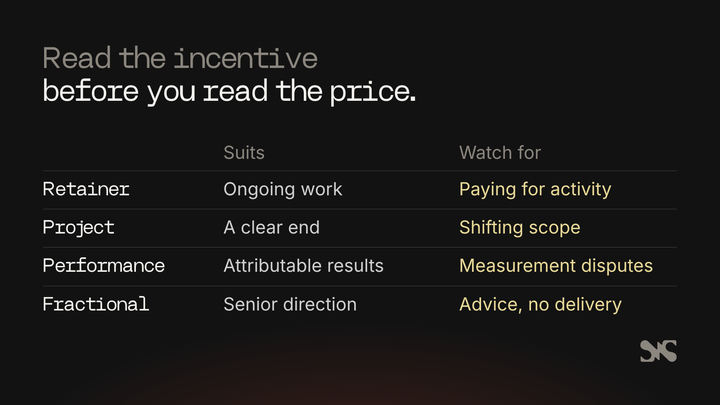
A monthly retainer buys ongoing capacity and is the most common model. It suits continuous work like SEO, content and demand generation. The risk is that it pays the agency the same whether you win or lose, and can reward activity over results. Manage it with clear outcome goals, not a deliverables checklist.
A project or fixed-scope engagement suits a defined piece of work with a clear end: a website rebuild, a positioning project, a technical audit. You get a predictable cost and a clear deliverable. It's a poor fit for open-ended growth work where the scope keeps shifting.
A performance or hybrid model ties some of the fee to results. It aligns incentives on paper, but only works when the outcome is genuinely down to the agency and both sides agree how it's measured. Vague performance terms cause more disputes than they prevent.
A fractional or advisory model buys senior time by the day or month. It suits companies that need direction more than hands. Confirm how many hours you get and whether the person is strategy-only or hands-on.
There is no correct model, only the one that matches your work and lines the agency's incentives up with your outcomes. Read the incentive before you read the price.
Red flags and green flags
Judge an agency on how specific its answers are, because vagueness in the sales process becomes vagueness in the work.
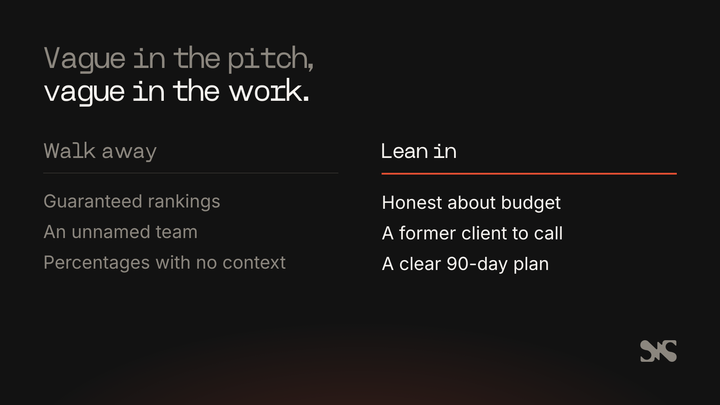
Red flags worth taking seriously:
- Guaranteed results or guaranteed rankings. Google is blunt about this: no one can guarantee a number one ranking on Google (Google Search Central, 2026).
- Reluctance to name the delivery team.
- Case studies with percentages but no absolute numbers or context.
- Reporting built entirely on vanity metrics.
- A pitch that never mentions your business model or stage.
- Pressure to sign quickly.
- No answer to “who isn't a good fit for you?”
Green flags worth weighting:
- Candor about your budget versus your goals, including telling you when they don't match.
- Willingness to give you a former client's contact.
- Specific, checkable examples from companies like yours.
- A clear ninety-day plan.
- An opinion, even one you push back on. A partner with a point of view beats a supplier who agrees with everything.
- A straight answer to “who shouldn't hire you?”, which only confident, well-positioned agencies can give.
How to choose a B2B SaaS marketing agency with a structured process
Run a short, structured process instead of a series of unstructured chats, because a consistent process is the only way to compare fairly and avoid being swayed by the best presenter.
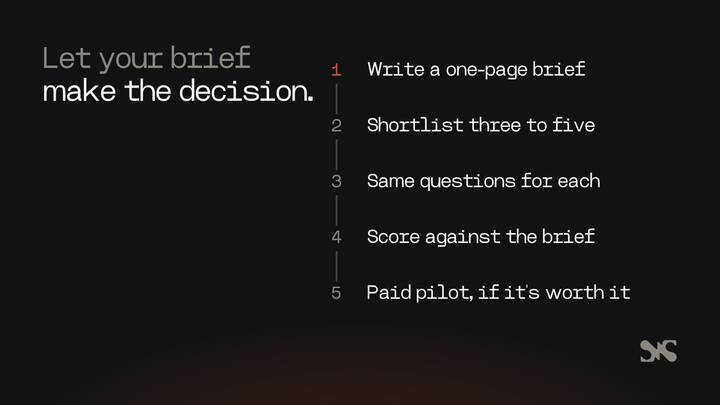
- Write a one-page brief from the requirements you defined at the start.
- Build a shortlist of three to five agencies whose proven niche matches the brief. Use directories and ranked lists to find candidates, then filter hard against your own criteria.
- Run the same conversation with each, asking the same core questions so you compare like with like.
- Score them against your brief, not against each other.
- Run a small paid pilot before a long commitment where the stakes and budget justify it. How an agency works in a real engagement tells you more than any pitch.
Know what a directory score can and can't tell you. SaaS Hackers scores agencies on public evidence across B2B SaaS focus, proof of results, transparency and reputation, and its review methodology is plain that the score is a researched starting point, not an assessment of delivery quality. It's there to help you build a shortlist and know what to ask on the first call. The decision still comes from your own process.
The whole point of a process is to keep your requirements in charge. The moment the agencies' pitches start setting your criteria, you've lost the thread.
Find and compare agencies suited to your needs
This guide gives you the framework. Finding the candidates is the next step. Browse the SaaS Hackers directory of B2B SaaS agencies and experts to build a shortlist with a track record in your niche, then filter it hard against the criteria above. If you're still deciding which channels need outside help at all, our guide to B2B SaaS digital marketing is a good place to start.
About SaaS Hackers
SaaS Hackers is a community of B2B SaaS marketing specialists and a directory of hand-picked agencies and experts with proven experience in B2B SaaS. It publishes guides, lists and templates to help founders and marketing teams make better buying decisions. No agency can pay to be listed or ranked. SaaS Hackers is run by Team 4, a B2B SaaS marketing agency that is listed in the directory and ranked on some lists.
FAQs
Some common questions, answered
How do I choose a B2B SaaS marketing agency?
Start with a one-page brief covering your stage, go-to-market motion, budget, in-house skills and the gap you need filled. Shortlist three to five agencies whose proven work matches it, ask each the same questions, check their case studies and references, score them against the brief, and run a small paid pilot if the stakes justify it.
Should I hire a specialist agency or a full-service agency?
Hire a specialist when the gap is clear, such as technical SEO or paid search, and someone in-house can coordinate the wider plan. Hire a full-service agency when your needs are broad, your team is small and you want one partner to own delivery. A fractional leader suits teams that can execute but lack senior direction.
How do I check an agency's GEO or AEO claims?
Compare them with Google's own guidance, which says AI Overviews and AI Mode need no special optimization beyond sound SEO. Ask what the agency would change, how it will measure results in Search Console and analytics, and whether it cites official documentation. Treat secret techniques, guaranteed AI visibility and unverifiable reporting as warning signs.
What are the biggest red flags when hiring a marketing agency?
Guaranteed rankings or results, an unnamed delivery team, case studies with percentages but no context, reporting built on vanity metrics, pressure to sign quickly and a pitch that never mentions your business model. Any agency that can't say who it isn't a good fit for probably hasn't thought hard about who it is a good fit for.
Is a retainer or a project fee better for a SaaS company?
Neither is better in general. A retainer suits continuous work such as SEO, content and demand generation, as long as goals are tied to outcomes. A project fee suits work with a clear end, such as a website rebuild or positioning project. Choose the model whose incentives match the work you need done.